Writing with our body to realign posture
- 25 Mar, 2026
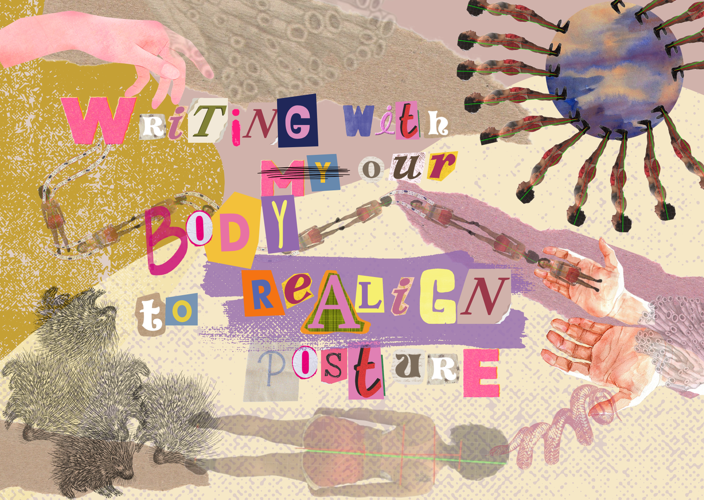
Writing with my our body to realign posture
1. Ivan
Ivan’s hands make me want to cry: tired, brave, persistent, healing. I want to cry at the injustice of it all — that I get this hour-long massage just for myself, where he moves and presses every part of my body; inserts needles, places cups, pulls my fingers, stretches my skin, rotates my joints. All of it, which I enjoy, while he —in a self-taught, resourceful English, stitching nouns together with barely any prepositions or adverbs— tells me he’s tired, that he works a lot, that his life is work home, home work, tired, need rest.
I understand why, on his one day off each week, he doesn’t feel like meeting the Ukrainian community in Glasgow: 20,000, two four zeros, he clarifies. We’ve had two appointments and both times he speaks about his homeland, always in a before and after. Any question I ask, he answers in two parts: before war, after war.
He’s been here three years. It was the cheapest direct flight out that he could take with his wife and two children, even though they had never heard of the city. He says life here is good, but people complain too much. He also says this —and points to his eyelashes— too long, then stretches his arm out about a metre in front of his face. He jokes —few words, many gestures— and I laugh before sinking my head back into the hollow of the table.
Sometimes I think he talks too much, and I want to relax into the massage, stop thinking, and drift into silence. And then I catch myself asking more. Everything he says makes me admire him. It stirs thoughts I don’t quite dare to voice: how hard would it be for him to have his own practice? How could I help him get his own table? If I could, I’d pay him privately, outside the centre where he works. He works from nine to seven, six days a week, with a one-hour break.
His hands do this all day and I feel the urge to kiss them.
He asks what I’m doing today.
I’m honest: I don’t know.
“That good plan,” he says, laughing.
I —who plan months in advance— decided to spend the day in the city without planning anything. I feel some embarrassment, even more when he asks if I have tomorrow off. Yes, I say —and silently wonder how to explain that I almost always am off. That I’m a full-time student and organise my time as I like. That on days like this, without plans and without my laptop, I look for spaces to loosen into creativity, to find new ways of shaping ideas, stories, feelings, images that flutter like restless butterflies in my mind. That his massage helps me do this, because it releases the tension in my body —and it is with my body that I write and create.
I spend much of my time reading, thinking, and writing about dialogue, conflict, and peace. My mind is busy imagining how to change this world —the one that pushes some to flee without even the privilege of stopping to think about it. I try to weave threads between my ideas and the sadness I feel at the restrained, contained way Ivan speaks about his country, the war, his life here, and his English. He doesn’t allow himself much anger: he mentions the war and then adds, ahhh, it is what it is.
I want to cry at the injustices: that some must leave, while others live off thinking. I want to cry that while I write this, drinking coffee with the sunlight on my face, he is still in that room, with another body, working through the hours —nine to ten, ten to eleven, eleven to twelve, and so on.
That during his lunch break he sits on a wall, among buildings and pavements damp from the relentless Scottish rain, thinking —I imagine— of those still there, waiting to finish his shift, go home, sleep, and return again tomorrow.
I wish he could feel the sun warming my forehead right now.
The other day it was warm and, as I said goodbye, I told him, “Have a nice day” —with a smile that exaggerated my kindness and hid a useless guilt.
He replied: no, you have a nice day.
Because by the time he finishes work, the sun —even if it’s still there— no longer warms.
2. Realigning Posture
Ivan is helping me realign my posture. My right shoulder sits higher, tense, pulling my whole body out of alignment. I’ve lived like this for years, with a pain in my shoulders and at the base of my neck that I’ve learned to carry. Stretching and yoga have never quite been enough; it always returns.
The body is a perfect system where everything connects. In pelvic floor physiotherapy they had me breathing with my diaphragm, hooked electrical currents to my ankles, and applied pressure to my tongue and jaw. All of it helps release tension in my pelvic floor.
I know it isn’t only my body that needs alignment —my mind and spirit do too. That has been harder work. Sometimes I forget and slip back. The world we live in —so fast, so material, so noisy, so blind, so automatic— threatens what I’ve managed to build.
But lately I’ve been able to hold it. I care for it, defend it: I meditate, I put my phone down, I spend time at my altar, I speak with my dead ones, I breathe, I nourish myself well, I step away from people whose energy drains me, I draw cards from my oracles, I read the words of medicine women, I write looser ideas —still unshared— and I search for the songs of blackbirds and sparrows the moment I step outside my door.
I’ve been this person for years, but quietly, in private.
Now it feels different.
I am challenging myself. I am creating myself.
I don’t quite recognise myself.
I like me. I thank myself.
I rush ahead, and I worry.
Don’t let it go away. Don’t let it slip away.
Don’t let the busy life take over.
I like giving myself a day without plans and finding myself in a café, writing freely across napkins, scraps of paper, the back of a printout I’m meant to read.
I write everywhere —and to do that, I had to let go of fixed ideas.
The doctrine of duties: fixed schedules, long hours. What I can or cannot be. What research can or cannot be. What I can or cannot say.
I rub out the to-do list from my whiteboard —it’s been there for years, maybe decades, never fully crossed out.
For a few days, I wrote nothing. Emptiness. Space.
Now I write phrases that move me.
I borrow them from friends,
from a song,
from a book.
Sometimes I invent them.
Sometimes they are questions.
I stay with the words:
I look at them while I get dressed in the morning,
I memorise and chew them as I walk,
I make them mine,
break them apart,
rearrange them.
I swallow them into my body
and wait,
attentive,
to see what grows.
I was too fragmented to sit with myselfWe are chained
Vivir en preguntas y no en respuestas
Too much life wasted
#mentejaula #mindcage
Today, during the session, it occurred to me that just as my body is made of cells in constant becoming, we humans are like cells in a larger body. And that body, too, has parts that tense up.
According to biodecoding and family constellations, the right side represents the father: authority, the professional, logic, the material.
I suspect our right side is hurting. That, like me, we carry one shoulder higher than the other. In fact, perhaps our whole right side is lifted, and what we need is urgent realignment.
We hold ideas as rigid as tight muscles pulling everything: the individual, the self, progress, the nation.
And when the body is pulled like that, it can only move in certain ways: through systems that are individualistic, competitive, extractive, bordered. In this posture, we are forced in one direction —always wanting more, and only for ourselves.
We are not allowed to stop.
Not allowed to lie down.
Not allowed to share the sky.
Not allowed a blank whiteboard.
If we are cells in a larger body, then some people are the right shoulder. They have built great things —good and bad— institutions, theories, countries, universities, companies. They’ve written books and had statues raised in their names.
Some see only their light; some of us also see their shadow.
And others are the left shoulder, or perhaps the eye, or a bare foot with a hardened sole, or the heart that sustains life, even when few recognise it. I don’t know what meanings these parts hold in somatic theories —if any— but I know that for thousands of years there have been those telling other stories.
Of the illusion of the self,
of radical interdependence,
of Mother Earth,
of truths beyond logic —
which, as Yasunari Kawabata wrote,
are found only by discarding words.
Today, there are people like Giuliana Furci[1], the Chilean mycologist, who —thinking about society and public policy through the lens of fungi— are even challenging our use of pronouns and nouns. A world where a tree is not an individual but “a photosynthetic symbiont of fungi”. I don’t fully understand it, but I understand the point: less focus on the singular, more on the relationship; less “I”, more “we” in a constant becoming.
Our larger body, like mine, needs to learn to move in better alignment. It needs the massage that stretches and releases, and the acupuncture that pierces a needle into the soil of rigid ideas.
And perhaps more than that, it needs to recover authentic dance, play, and contact.
To hang like bats, seeing the world upside down. To draw close, like porcupines in winter —as in Schopenhauer’s metaphor— willing to risk that point of vulnerability and warmth. To crawl like snakes, just to remember how to feel the world beneath.
Not everything can be upright posture and active breaks.
3. The bleeding body
I wrote these words months ago, when Gaza and Ukraine were being bombed. They still are, and now we must add Iran, along with small and big vessels across the oceans. In months to come, more will have to cry for theirs.
Our larger body is bleeding.
As I write, I feel this body bleeding.
Because we have always bled, some say it is inescapable—that this is what we are. That a world where all beings —human and more-than-human— can flourish - is impossible.
But in recent years I’ve been paying attention, and I’ve found voices that, like needles, question what is real and what is possible. Voices like bell hooks, Gloria Anzaldúa, Cecilia Vicuña, Arturo Escobar, john powell, Thich Nhat Hanh, Joanna Macy, Audre Lorde, David Bohm, Isabella Hammad, Silvia Rivera Cusicanqui —and many more. Not only recognised authors, but also friends and activists. Names I scatter here, in the hope they might catch someone’s attention.
Their words have stretched out my fixed ideas and made me think that the real —and the possible— will be whatever we can imagine.
So I’ve set myself to writing: writing a world I do not yet know.
And it has been difficult, because to write that world is also to write the worlds that must fall.
For three weeks I drafted texts.
Texts that could hold my howling, as a woman reading the perverse news about Epstein and the most powerful men in the world.
Texts that brought the stories of Manhattan closer to my country, my city, my life, my body, my friends’ bodies —to the pain we’ve shared and held together as we heal.
Texts that could contain the agony of humanity rotting in any attempt to justify the bombing by Israel and the United States of a school in Minab, in the south of Iran, where nearly 200 schoolgirls and their teachers were killed.
But everything I wrote I deleted or abandoned, overwhelmed by emotions that spilled beyond what I could write.
And then I remembered Ivan who, months later, is still working, still massaging, every day. The same conflicts remain. Mine —this dissonance of caring deeply about a world I don’t have to endure, in a life full of privileges. His —which I can only imagine from a distance— missing a homeland from within a narrow room, where the window faces another wall.
His hands,
like so many others,
are both tool and tragedy,
strength and survival,
opportunity and sentence.
For me us,
and for these words to exist,
his hands are more than necessary.
Notes
Thanks to my friend Florencia for reading me, for her incredibly valuable comments, and for inspiring my artistic ability in collage. Thanks to my friend Caro for her editorial assistance with the English version of this text.
[1] The interview I’m sharing isn’t publicly accessible, but if anyone wants to read it, write to me, and we’ll sort it out.
Dejar un comentario
Cargando comentarios...