When Bees, Orchids, and a Toroid Joined the Dialogue
- 09 Feb, 2026
It was a workshop that ran from Friday to Sunday in Tenjo, on the outskirts of Bogotá. It was called “Technologies to Cool the Earth: Multispecies Digital Workshop/Performance”. From the title alone, I wasn’t sure what it was about. Still, after meeting Bárbara — one of the facilitators — at a birthday party, I signed up without thinking twice.
We talked about what we each did. Both of us, you could say, worked in what is known as peacebuilding in Colombia — a name that has never sat entirely comfortably with me—. She was deeply involved in processes with sabedoras, women knowledge keepers in the Amazon. I don’t remember exactly what we talked about, or which questions were occupying my mind at the time, but I suspect they related to my growing frustration with how human-centered and rationalist the world I inhabit tends to be. In any case, when she told me about the workshop, I thought: this is it — I need to go.
I remember reading the presentation they shared with us and having to go over it more than once to understand what we would actually be doing: “activities in which participants will explore the controversies that arise from tracing the relationships among the various beings that inhabit a territory.” I encountered phrases like “an extended dramaturgy” and “playing the role of agents within a network of relationships.” Writing this now, I notice a certain embarrassment in admitting how foreign those ideas felt to me at the time. I didn’t come from the arts or environmental movements. I brought little more than an inquiry with me.
The place I arrived at, Organizmo, felt like peace and purpose. Surrounded by deep green, among tall and medium-sized trees, beautiful structures appeared, quietly suggesting that you were entering a special place. We were welcomed by Ana, the project’s director: a young woman with a warm gaze and gentle smile, whose presence felt entirely in tune with the place. An architect, if I remember correctly, who, together with a team of collaborators, has brought this space to be a living space. They call it a Center for Regenerative Learning and Intercultural Knowledge Exchange.
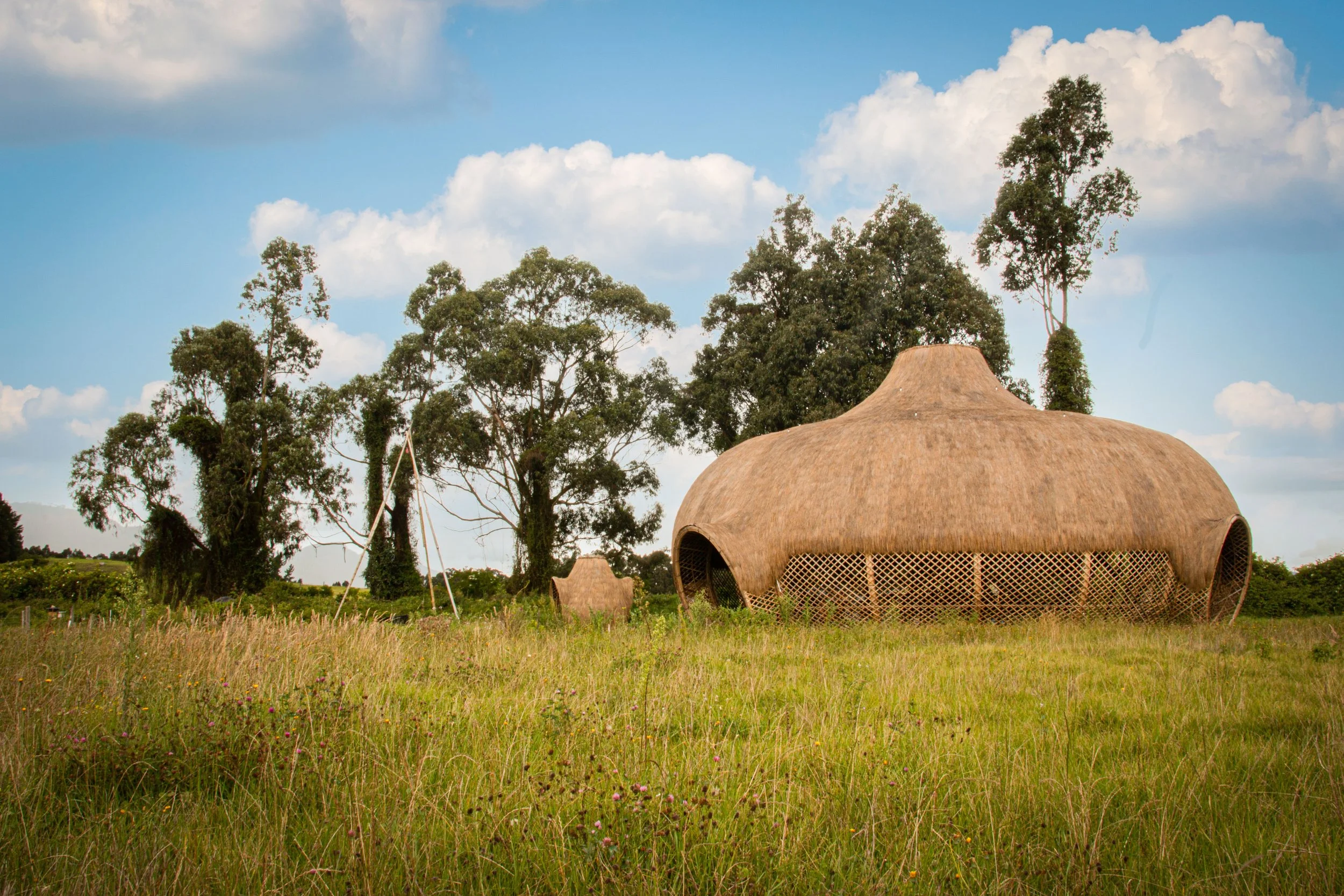
_Image taken from _Construcción Toroide — ORGANIZMO
They gave us a short tour of the land, showing us crops, trails, and each small structure scattered throughout the terrain. None drew attention quite like the Toroid. Seeing it emerge provoked an almost mystical reaction — something closer to feeling than understanding. It carried an important, nearly sacred presence. The Toroid is, quite simply, la* Casa del pensamiento*, the House of Thought.
On Organizmo’s website there is a section dedicated to the Toroid [1], which I encourage anyone to read. I feel intimidated describing it myself: What can I say without falling short? What if I say too much? Perhaps the first line in the website is enough: *Architecture is the representation of our relationship with territory._ The Toroid is an example of vernacular architecture — traditional, locally rooted, grounded in ancestral knowledge — and it is a sacred space where thought is practiced. I remember being told that a group of knowledge keepers and _taitas *(wise elders) had traveled from different parts of the country to ceremonially open the space. It was also where, on the first night, we lit a fire, shared words, and began the work we had come to do.
Most of us attending the workshop — around twelve people— came from cities and were in our twenties or thirties, with a few slightly older. I remember many artists, several people closely connected to ecological work, and everyone, of course, deeply interested in environmental questions. Shortly after arriving, we shared a delicious vegetarian lunch (and I must pause to say that the food was extraordinary).
I was among the last to arrive, so everyone was already seated at a long table, and they had to make space for me. I sat down between strangers, self-conscious as a newcomer.
The round of introductions began quickly. I still remember the nervousness — the mild awkwardness — of having to say what I had studied. Perhaps it wasn’t necessary, but it is what we tend to do. Supposedly, it says a great deal about a person, though in my case, it often surprises or confuses people. Depending on how much I choose to share, introducing myself can also become an opportunity to uncover internal tensions and expose my own vulnerability — rich material to write about. I have grown accustomed to adding a disclaimer after naming my degree: “I studied economics, but I’m not an economist.” When I said it, someone smiled at me with a sense of quiet complicity and replied, “I’m a software engineer and a poet.” It was Eugenio, the other half of the team leading the workshop.
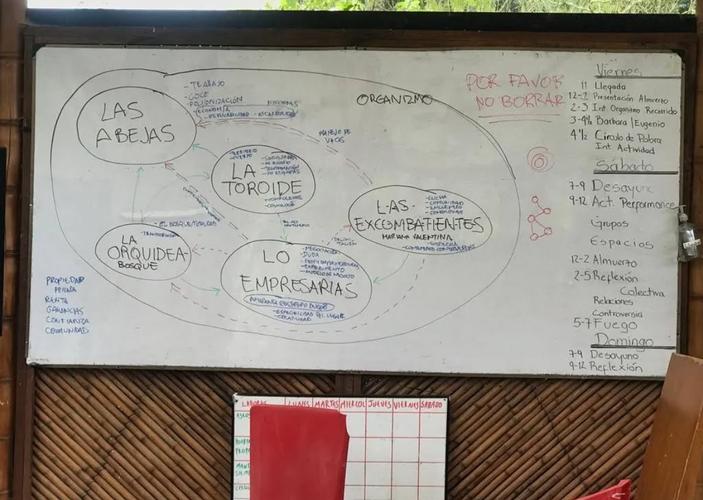
The workshop revolved around a fictional case involving land-use conflict among different actors. On the human side were women signatories of the peace agreement — former FARC combatants — who had received funding to start a productive project and had purchased cows for a dairy business.[2] There were also carbon credit entrepreneurs interested in planting trees. On the non-human side, three participants completed the scenario: bees, forest orchids, and the Toroid.
We divided into pairs and each chose a role. We would spend the weekend inhabiting the territory from that perspective, using Ojovoz — a simple digital tool that allowed us to document the environment with our phones by uploading photos, audio, text, and GPS points onto a territorial map.
Gradually, I began to understand what the workshop was inviting us into: stepping into each role as a way of exploring alternative ways of being in, seeing, and listening to the territory. There was a strong element of play and curiosity, along with an invitation to step outside the comfort zone of distant, abstract thinking — the kind that happens while sitting in a chair from which we feel capable of speaking about anything. I experienced this shift as we moved through the exercises. What opened up when we put our bodies into walking, smelling, and sensing the territory? What became possible if we lay on the ground, looked at the world upside down, or spent hours observing an apparently immobile orchid?
Could something new emerge?
From that exploration would come the materials we would later bring into dialogue. After all, there was a conflict to address: land use.
There is little need to prove that this tiny fictional scenario — which, in post-Peace Agreement Colombia, was not entirely fictional — captured, I would dare say, the essence of nearly every conflict we can imagine: the issues I have worked on throughout my professional life, the deepest causes people dedicate themselves to, the headlines of news cycles across the globe, and the questions we still struggle to answer. It contained the kernel of countless debates I have witnessed over the years working in social dialogue. By the time I attended this workshop, I had already spent about six months as part of Valiente es Dialogar (Brave to Dialogue), a space that, from the very beginning, challenged and inspired me to think deeply about a question that has remained with me ever since it first entered my life: how do we approach difference?
What impacted me most about the workshop was its framing. We stepped out of the frantic rhythm of city life to dedicate time to inhabiting this collective experiment. We created space to step outside established molds — in every sense. And something that now feels obvious, but at the time deeply surprised me: orchids, bees, and the Toroid were treated as active participants in both the methodology and the dialogue. They had a voice.
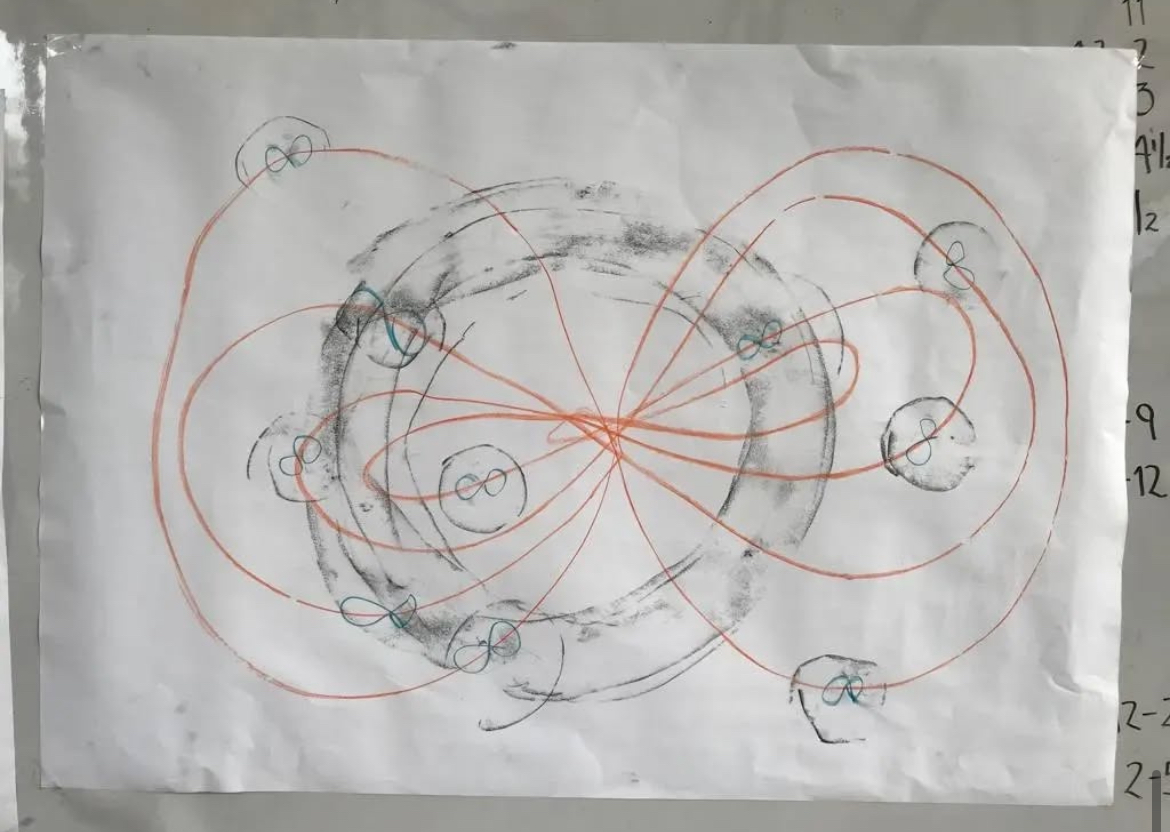
The message that The Toroid sent (and on that day, she requested that we refer to her in feminine).
Being very much myself, I chose the role farthest removed from my reality and partnered with Lucas to become the Toroid. I wanted to know what it would be like to spend two days exploring Organizmo from its presence. What would it mean to attempt to connect with the agency of something so intangible and, at the same time, so immense?
Answering that fully would require another essay — and even then, words might fail. What I can say is that it was a humbling and hopeful experience. Ideas, sensations, words, images, and movements emerged as invitations to inhabit a perspective often overlooked — one that spoke to the territory, to the vast scale of time and the universe, and to the brevity and limits of our human presence. It offered a way of seeing that helped situate us: we are not as large as we often imagine ourselves to be, and given the scale of the damage we are causing, that realization brings a quiet sense of relief. Yet it was also a perspective that invited reflection on humanity’s role within these conflicts, and on the tools we possess to shape the futures we seek.
What shook me most was the sense of freedom: the space we were creating to explore and invent alternative technologies capable of helping us do what we continue — and will always continue — to need to do: approach difference and transform conflict. It shook me because, over the years I have developed a hunger for forms of exploration that allow us to do things differently — where play, art, ritual, digital tools, curiosity, sensitivity, the body, the senses, and personal experience work alongside argument, data, research, and analysis. Or where human eyes join forces with the trillions of other eyes surrounding us that ultimately compose everything we are.
I will anticipate an answer some readers might be expecting: no, we did not find “the solution” to land-use conflict. But we expanded the dialogue and reached places we would not otherwise have reached. We shifted attention away from isolated units and toward relationships. We situated ourselves within a far broader sense of space and time than we are accustomed to inhabiting. We stretched thought itself — and stretching thought changes reality. I know this because, at the very least, it changed mine.
Not long afterward, while searching for postgraduate programs, I established a criterion: to find schools where there would be space to challenge anthropocentrism and allow for far greater creative exploration than the traditional academic environments I had previously known. That is how I arrived at the School where I now study. I quickly realized that I was arriving “late” to conversations that have been unfolding for decades, both within and beyond academia. Even more striking was discovering the vast universe of initiatives that move beyond conversation and dare to explore embodiment, performance, multispecies thinking, the unconscious, play. I was not arriving late. I simply needed to arrive.
Perhaps one lingering feeling remained after the workshop: a wish that the group had been composed of people who were ‘truly’ very different from one another. In many ways, we had a lot of similarities—we had all chosen to be there. My more imaginative side kept wondering what a similar exercise might look like with the actual people living within these conflicts: decision-makers; those who lean toward the mono and those who lean toward the plural; those who have much and those who have little; those who carry visible pain and those who do not even notice it; those who explain and those who recite; those who speak constantly and those who listen.
Of course, this may sound naïve. Real life requires navigating identities, egos, interests, power, violence, wounds, trauma, timelines, agendas, resources, and an endless list of complexities — one in which the word wounds appears all over. And yet, the experience stayed with me as a kind of compass: how do we break the molds through which we approach this work, and why is it worth continuing to try?
Note: Thank you for reading this first entry. For those interested in learning more about the work of some of the people I mention, here are their links: Bárbara Santos can be found on Instagram as @quiasma. Eugenio Tiselli’s work can be found here, and Organizmo here.
[1] The website is mainly in Spanish, but an automatic translator could help!
[2] This workshop took place six years after the peace agreement between the Colombian government of President Juan Manuel Santos and the FARC guerrilla, which resulted in the demobilization of approximately 13,000 former guerrilla combatants.
Dejar un comentario
Cargando comentarios...